
Listen to this Post
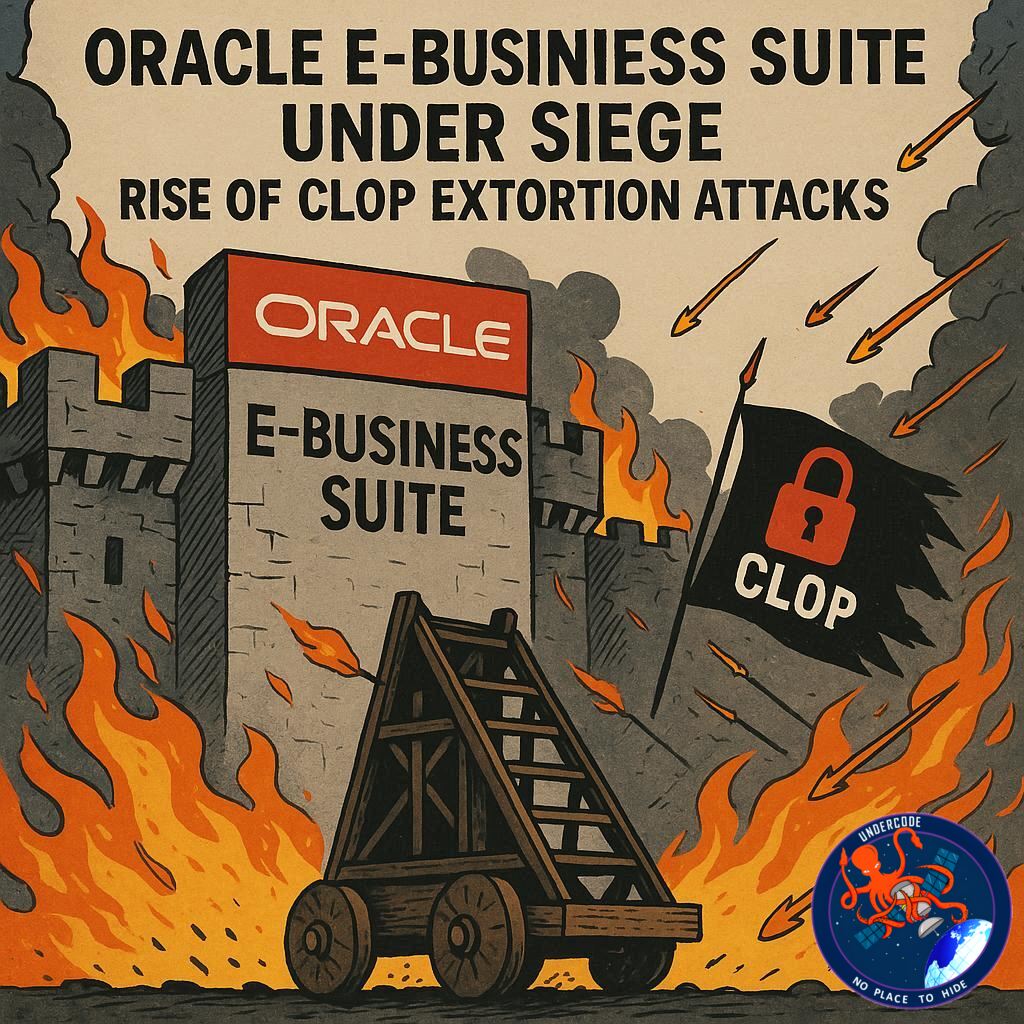
The digital fortress that businesses rely on—Oracle E-Business Suite (EBS)—has come under a sophisticated wave of cyberattacks. In late 2025, cybersecurity researchers from Google Threat Intelligence and Mandiant uncovered a massive extortion campaign exploiting EBS vulnerabilities, threatening companies with stolen data and ransom demands. The campaign, linked to the notorious Cl0p ransomware group, has highlighted the growing risks organizations face when critical enterprise software is targeted by coordinated, high-stakes cybercrime.
In October 2025, Google and Mandiant began tracking an extortion campaign targeting Oracle E-Business Suite users. The attackers exploited vulnerabilities patched in July and likely a zero-day flaw (CVE-2025-61882) to access sensitive company data. Using a combination of compromised email accounts and default password reset mechanisms, threat actors stole valid credentials, enabling them to launch mass extortion campaigns targeting corporate executives.
The extortion notes included Cl0p affiliate references, though Google could not fully confirm the claims. At least one compromised account linked to the financially motivated FIN11 group. Mandiant CTO Charles Carmakal confirmed attackers were using hundreds of hacked accounts to maximize the impact of these campaigns.
Oracle responded with an emergency patch addressing CVE-2025-61882, a critical vulnerability with a CVSS score of 9.8, affecting EBS 12.2.3–12.2.14 (BI Publisher Integration). The flaw allowed unauthenticated remote attackers to take control of the Oracle Concurrent Processing component via HTTP. CrowdStrike confirmed that Cl0p, also known as Graceful Spider, exploited this vulnerability to steal data.
After a proof-of-concept (POC) disclosure on October 3, cybersecurity researchers warned that exposed vulnerabilities would likely fuel additional attacks targeting Internet-facing EBS instances. Observations revealed attackers exploiting HTTP POST requests to bypass authentication, then manipulating Oracle’s XML Publisher Template Manager to upload malicious XSLT templates. These templates executed commands directly in memory, enabling the installation of web shells and persistent access without leaving traces on disk.
The attack chain was highly sophisticated: initial infiltration often started weeks before Oracle’s patch, reconnaissance included running system commands like ifconfig and netstat, and attackers maintained interactive bash shells for real-time control. GTIG and Mandiant noted overlaps with FIN11 and CL0P malware, suggesting a shared toolkit or knowledge base between threat actors. The campaign demonstrated the effectiveness of leveraging zero-day vulnerabilities and delayed extortion to exfiltrate data while remaining undetected.
What Undercode Say:
The Oracle E-Business Suite extortion campaign exposes a deeper truth about modern ransomware and corporate cybersecurity: attackers are becoming surgical, not just brute-force. By combining zero-day exploitation, mass credential compromise, and in-memory payload execution, threat actors achieve high-impact results with minimal footprints. The use of malicious XSLT templates illustrates an evolution in attack techniques where enterprise software features, intended for functionality, are weaponized for control.
The campaign also underscores a critical flaw in organizational defense: overreliance on standard patch cycles. Even when patches exist, attackers often exploit the window between disclosure and implementation. By targeting executive-level accounts for extortion, attackers not only aim for financial gain but also seek leverage over decision-making within organizations.
Technical observations indicate attackers blend sophistication with adaptability. They integrate reconnaissance, persistence, and multi-layered access, making detection difficult for traditional monitoring tools. By reusing components from prior FIN11 and CL0P campaigns, these groups demonstrate the emergence of semi-shared threat ecosystems, where malware and tactics circulate among financially motivated actors.
The broader implications for businesses are significant. Any organization running Oracle EBS, particularly versions affected by CVE-2025-61882, must adopt proactive threat hunting and memory-based detection strategies. Traditional perimeter security and reactive patching are insufficient against adversaries leveraging zero-days and in-memory payloads. Furthermore, the campaign emphasizes the need for monitoring executive email security, as compromised accounts remain a preferred vector for extortion.
Analytically, this attack reflects a growing trend in cybercrime: blending technical sophistication with psychological manipulation. By threatening executives directly, attackers capitalize on fear and urgency, often accelerating ransom payouts. Moreover, the rapid reuse of POCs by other groups highlights how quickly vulnerability knowledge propagates in underground cybercrime communities. This not only increases attack velocity but also diversifies potential targets beyond the initial victims.
From a strategic standpoint, companies must rethink risk management. Layered security, continuous monitoring, and zero-trust principles are essential. Organizations should simulate these attack vectors internally, ensuring web applications, templates, and administrative accounts cannot be easily weaponized. Corporate cyber insurance policies may also need to adapt, accounting for the heightened threat of executive-targeted extortion campaigns.
The campaign also poses questions for regulators and software vendors. How should zero-day disclosures be managed? What is the responsibility of vendors like Oracle to accelerate patching and proactive alerts for high-risk exploits? These incidents demonstrate that cybersecurity is no longer just an IT concern but a strategic business issue, where operational disruption, financial loss, and reputational damage are all intertwined.
Looking forward, the Cl0p and FIN11-linked activities suggest a persistent threat landscape. Organizations with unpatched or Internet-exposed Oracle EBS instances remain highly vulnerable. Continuous intelligence sharing, behavioral analysis, and executive awareness are not optional—they are critical defenses against this evolving class of threats.
Fact Checker Results:
✅ CVE-2025-61882 is a real Oracle EBS vulnerability with a CVSS score of 9.8.
✅ Cl0p ransomware group has been linked to recent Oracle EBS extortion campaigns.
❌ There is no confirmed public evidence that all claims in the extortion emails are factual.
Prediction:
📊 The Cl0p campaign marks a shift toward executive-targeted ransomware and zero-day exploitation. Expect an increase in similar attacks against high-value enterprise software. Companies will face pressure to implement rapid patching, memory-based detection, and proactive threat hunting to prevent mass data exfiltration. Threat actor collaboration and shared toolkits are likely to accelerate, creating a more dynamic and high-risk cybercrime ecosystem.
🕵️📝✔️Let’s dive deep and fact‑check.
References:
Reported By: securityaffairs.com
Extra Source Hub (Possible Sources for article):
https://www.discord.com
Wikipedia
OpenAi & Undercode AI
Image Source:
Unsplash
Undercode AI DI v2
Bing
🔐JOIN OUR CYBER WORLD [ CVE News • HackMonitor • UndercodeNews ]
📢 Follow UndercodeNews & Stay Tuned:
𝕏 formerly Twitter 🐦 | @ Threads | 🔗 Linkedin | 🦋BlueSky | 🐘Mastodon


