
Listen to this Post
Introduction
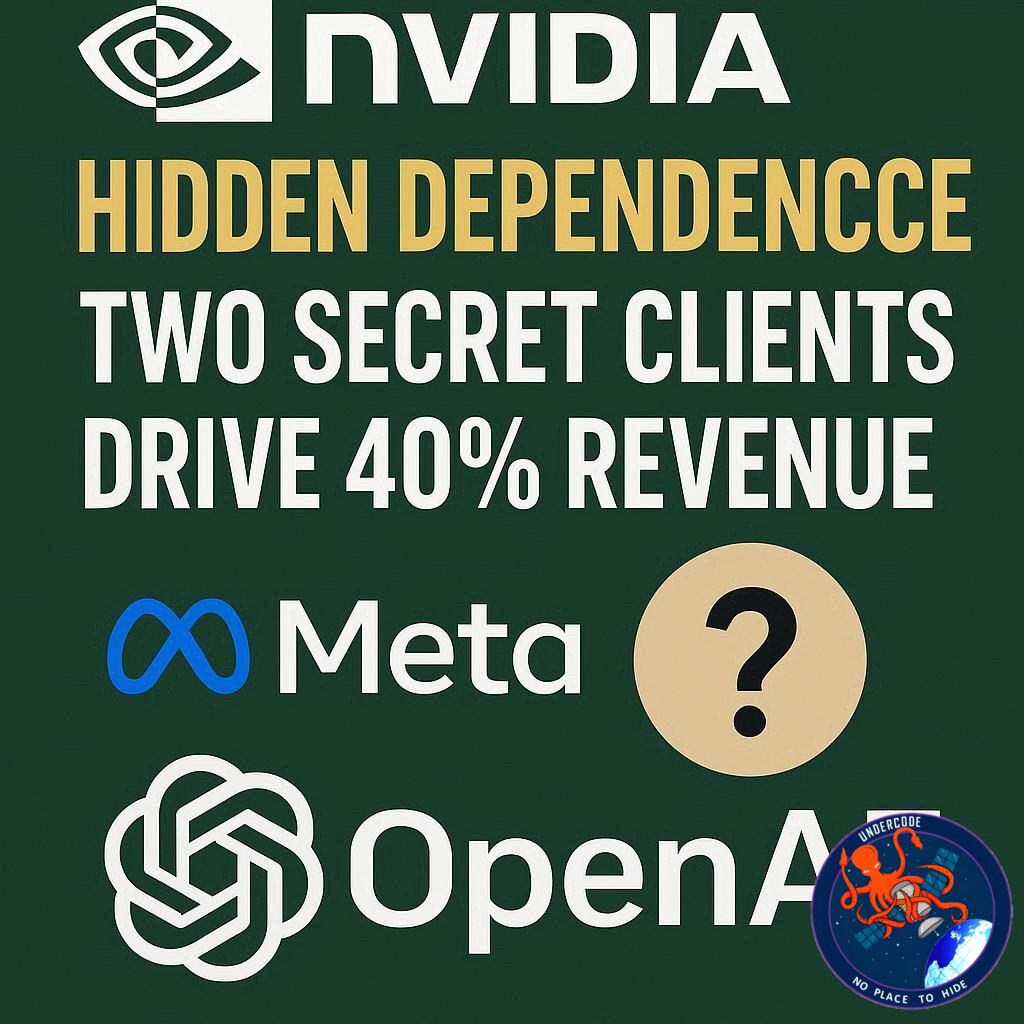
Nvidia has become the face of the global AI boom, powering everything from data centers to cloud platforms. But behind its impressive financial numbers lies a major concern—its dependence on just a handful of clients. A recent U.S. Securities and Exchange Commission (SEC) filing revealed that nearly 40% of Nvidia’s revenue for the July quarter came from only two customers. While the company has not disclosed their identities, speculation points toward some of the world’s largest cloud providers. This raises important questions about Nvidia’s business model, future risks, and its ability to maintain dominance in the competitive AI infrastructure market.
the
In its latest SEC filing, Nvidia revealed that two unidentified clients—labeled “Customer A” and “Customer B”—accounted for 23% and 16% of revenue, respectively, in the July quarter. Together, they made up nearly 40% of the company’s sales. For the first half of the fiscal year, these clients contributed 20% and 15% of total revenue. Both were listed as direct customers, meaning they purchased Nvidia chips to assemble into systems or circuit boards before selling them to data centers, cloud providers, or end-users.
Direct customers are not the actual end-users of Nvidia products. Instead, they act as intermediaries—manufacturers like Foxconn or large system builders who integrate Nvidia’s hardware into broader platforms. Indirect customers, on the other hand, include big cloud service providers and internet companies, which typically buy from Nvidia’s direct clients.
Nvidia’s Chief Financial Officer, Colette Kress, noted that large cloud providers alone generated nearly half of its data center revenue, a segment that accounted for 88% of Nvidia’s overall sales. The company admitted that revenue concentration among a few clients has been a recurring trend and could continue in the future.
Although Nvidia has not confirmed the identities of “Customer A” and “Customer B,” market analysts believe they could be tech giants like Microsoft, Amazon, Google, or Oracle—companies leading the global AI race. Analysts also warned that Nvidia’s earnings growth now heavily depends on cloud companies’ spending on AI infrastructure. HSBC’s Frank Lee commented that further earnings upside may be limited without clarity on 2026 capital expenditure plans.
Despite these concerns, Nvidia remains bullish. CEO Jensen Huang projects the AI infrastructure market could reach \$3–\$4 trillion by the end of this decade, with Nvidia aiming to capture a dominant share. Demand is not only coming from major cloud providers but also governments, enterprises, startups, and smaller “neoclouds” specializing in AI-driven services.
What Undercode Say:
Nvidia’s position is both powerful and precarious. The revelation that two customers contribute nearly 40% of revenue underscores a classic concentration risk. While it is common for B2B tech companies to rely on a few major clients, the stakes for Nvidia are far higher. This is because the AI boom is not evenly distributed—it is largely being fueled by a handful of hyperscale cloud providers. If one of these giants slows spending, pivots strategy, or turns to competitors like AMD or custom chip designs, Nvidia could face a significant revenue hit.
The fact that Nvidia labels them as “direct customers” hints that system integrators—possibly Foxconn or other large OEMs—may be involved. However, given that almost half of Nvidia’s revenue comes indirectly from Microsoft Azure, Amazon Web Services, Google Cloud, and Oracle, it is highly likely that these hidden clients are deeply tied to the hyperscaler ecosystem.
From a strategic standpoint, Nvidia has two options:
- Deepen lock-in with hyperscalers by offering proprietary AI software stacks (like CUDA) and exclusive hardware partnerships.
- Diversify revenue streams by expanding into government AI infrastructure, enterprise AI, and consumer-facing applications such as gaming, robotics, and automotive AI.
Investors should also note the timing of disclosures. Nvidia knows Wall Street is worried about revenue dependency, yet the company chose not to reveal client names—possibly to protect negotiations or prevent competitors from gaining leverage. This secrecy could signal ongoing deals or tensions with hyperscalers over pricing and supply contracts.
Another key angle is competition. AMD’s MI300 AI accelerators and custom chips from companies like Google (TPU) and Amazon (Trainium) could gradually reduce Nvidia’s dominance. If Nvidia remains tied to only a few hyperscalers, it risks being sidelined if those companies push harder for in-house chip design.
Yet, Nvidia’s optimism is not misplaced. The projected \$3–\$4 trillion AI infrastructure market suggests enormous opportunity. Even if hyperscalers cut back slightly, governments and enterprises worldwide are ramping up AI adoption. The emergence of “neoclouds”—smaller, specialized providers—could also help Nvidia broaden its customer base and reduce overreliance.
Ultimately, the company sits at a crossroads: a monopoly-like position in AI chips, but one vulnerable to strategic shifts by its largest customers. The coming years will determine whether Nvidia can balance dependency with diversification—or whether its golden era of AI growth will face turbulence.
🔍 Fact Checker Results
✅ Nvidia’s SEC filing confirms two clients contributed \~40% of revenue.
✅ Cloud providers generated half of Nvidia’s data center revenue (88% of overall sales).
❌ Nvidia has not confirmed the identities of “Customer A” and “Customer B”—market speculation remains unverified.
📊 Prediction
Nvidia’s dependence on two major clients will remain a double-edged sword. Over the next 2–3 years, the company will likely deepen ties with hyperscalers to secure recurring AI chip demand, but risks will rise as Amazon, Google, and Microsoft accelerate in-house AI hardware. By 2027, Nvidia may face its first real revenue shock if even one of these giants scales back orders. However, diversification into governments, startups, and neoclouds could cushion the blow, ensuring Nvidia maintains a dominant—though more contested—role in the trillion-dollar AI infrastructure market.
🕵️📝✔️Let’s dive deep and fact‑check.
References:
Reported By: timesofindia.indiatimes.com
Extra Source Hub:
https://www.facebook.com
Wikipedia
OpenAi & Undercode AI
Image Source:
Unsplash
Undercode AI DI v2
🔐JOIN OUR CYBER WORLD [ CVE News • HackMonitor • UndercodeNews ]
📢 Follow UndercodeNews & Stay Tuned:
𝕏 formerly Twitter 🐦 | @ Threads | 🔗 Linkedin | 🦋BlueSky | 🐘Mastodon


